ATLAS KASBAH
Gold medal at the World Responsible Tourism Trophy in London
Meals in an unparalleled atmosphere
Moroccan cuisine is part of the Mediterranean diet, a UNESCO Intangible Cultural Heritage, thanks to its high-quality ingredients, flavors, spices, and health benefits. Atlas Kasbah invites you to discover this cuisine in a relaxing atmosphere, on the terraces or in the restaurant.
Vegetarian cuisine available upon request.
Culinary inspiration
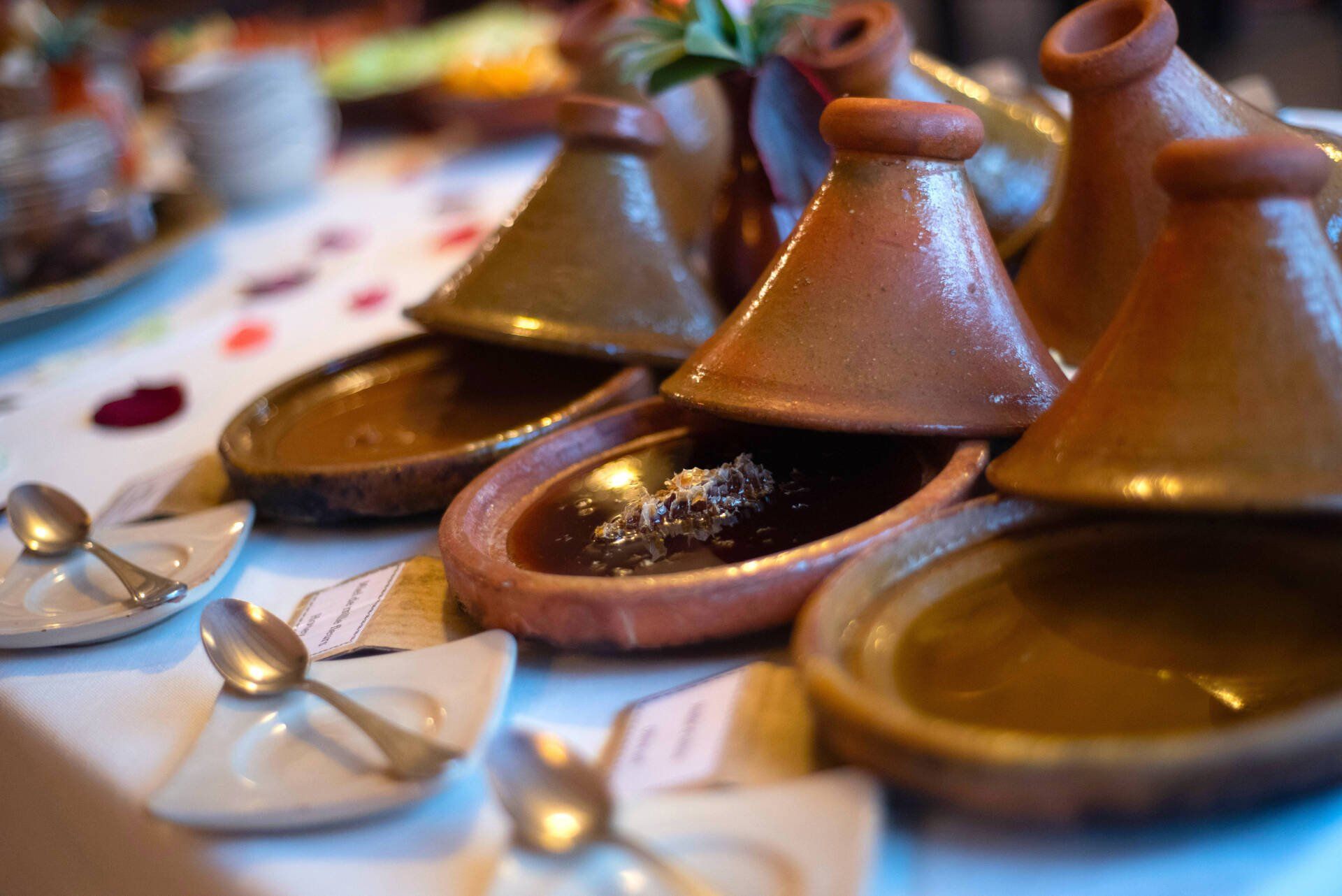
Atlas Kasbah's cuisine gives pride of place to local products such as argan oil, different kinds of honey, goat cheese from a women's cooperative, fruits and vegetables freshly harvested from our orchard or vegetable garden, barley couscous prepared by hand by the women... All these products are meticulously prepared by our chef who enhances them through dishes with exquisite flavors.
Restaurant for non-residents
The Atlas Kasbah restaurant is open to non-guests by reservation only. Contact us to reserve a table.
We welcome you to the restaurant or to one of our terraces with panoramic views of the Atlas Mountains and the argan grove, the cradle of the precious and succulent argan oil.
Moroccan cooking classes
Learn how to choose the right ingredients, master the art of making a tagine, and fold a briouat. Our chef will guide you in preparing a delicious Moroccan menu in our teaching kitchen. Two different menus are offered in our Moroccan cooking workshop.
Note: Atlas Kasbah does not have an alcohol license, but you can buy alcohol at the Carrefour supermarket, a 5-minute drive from the ecolodge, and consume it in the restaurant. We do not charge a corkage fee.
For those who wish to have dinner in a restaurant in Agadir, we close the outer gate of the ecolodge at 11pm.
Climate-friendly dishes
Atlas Kasbah offers Climate Good Menus in Morocco, an initiative created by the Sustainable Tourism project of GIZ, German cooperation and the High Commission for Water and Forests (HCEFLCD).
The principle is to offer menus with at least one starter, one main course and one dessert that meet the following three criteria:
The season
The products are fresh and seasonal. A fresh, locally grown, seasonal vegetable generates 7 times less greenhouse gas (GHG) than a frozen vegetable and 20 times less than an imported, out-of-season fresh vegetable.
The plant
Vegetable production generates 10 times fewer greenhouse gas emissions than animal production. Therefore, cereals, vegetables, fruits, and legumes are prioritized. To supplement this, poultry, rabbits, fish, shellfish, etc., are also used.
The premises
According to the French association's "good for the climate" standard, ingredients must be produced within 200 km. The Souss Massa region is particularly well-suited as Morocco's leading fruit and vegetable region, and a major supplier of seafood and local produce.
Why a climate-friendly menu?
A climate-friendly menu is beneficial in several ways: better product traceability, development of trusting relationships with suppliers, better quality products, environmental preservation...
Climate-friendly menu
Download the climate-friendly recipe booklet from the hotels of Marrakech and Agadir